
Three Trends that will Reshape Aquaculture Health by 2030
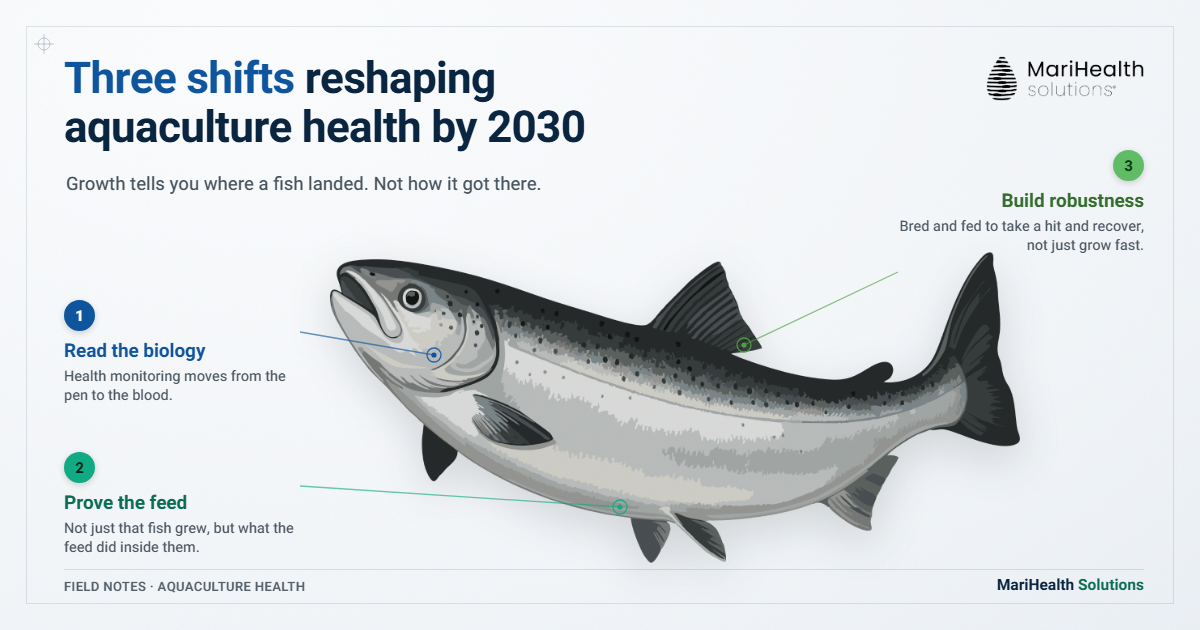
The next five years of fish health get decided inside the animal, not on the growth curve.
Most conversations I have with people who feed fish for a living (feed formulators, fish health scientists, farm managers) seem to surface the same theme: the key performance metrics looked fine, so we didn't think to look any deeper.
The numbers usually are fine. Growth is on track, FCR sits where it should, the fish are the right size on the right day. Those are the metrics the industry has trusted for decades, and they have carried it a long way. But they are outcomes. They tell you where a fish landed, not how it got there, and not what it is quietly spending to stay there.
That gap, between how a fish looks on paper and how it is actually coping, is where I think the next five years of aquaculture health get decided. Here are three shifts I wouldn't be surprised about in 2030.
1. The animal becomes the data source
For a long time, reading a fish's biology in any depth meant killing it. That single fact has shaped how often anyone actually looks. This year the rules started to move: Norway granted its first regulatory clearance for non-lethal blood sampling of Atlantic salmon, lifting a restriction that had stood for years, and the first monitoring rollouts across producer networks are now underway.
Put that next to the spread of on-farm sensors tracking water and behaviour in real time, and a genuine shift in how the industry talks about AI, from automation toward the biology itself, and the direction is hard to miss. We are moving from watching fish to reading them.
Where I think the value sits is breadth. A single marker tells you one thing. The blood proteome carries thousands of signals at once, so you see whole systems move together rather than one number in isolation. That is the layer we work in. Not a replacement for the checks that already earn their keep, a wider-angle lens on the same animal.
2. Feed has to prove what it does inside fish
The proverbial feeding trough is being rebuilt faster than in a generation. The UK's five largest supermarkets have pledged to cut their reliance on wild-caught fishmeal and fish oil, targeting a fish-in, fish-out ratio below by 2030. An El Niño-hit anchovy season cut global fishmeal production by 23% year on year, and prices have since pushed to around $2,500 a tonne. Single-cell proteins are forecast to grow roughly tenfold by 2030, insect meal is moving from pilot lines into industrial plants, and algae is coming up fast behind it.
Here is the part worth sitting with. Two feeds can post near-identical growth and FCR and still do quite different things to the animal underneath. Metabolism, immune function, stress response. "The fish grew fine" and "the fish is unchanged" are not the same statement.
So, as diets get rebuilt around ingredients the fish has never eaten before, "it grew fine" stops being enough. Buyers, certifiers and producers are going to want biological evidence that a new formulation didn't quietly cost the animal something the growth curve can't see. Growth and survival are the endpoints. The functional biology is how you arrived at them, and it is the layer a proteomic screen reads: thousands of proteins at once, sitting alongside the metrics these trials already track, not on top of them.
3. From chasing growth to building robustness
Genetics is now standard practice, not a frontier. One Mediterranean breeding programme lifted harvest weight by 76% over two decades, and AI is starting to predict how an edited trait could behave in a real pen rather than a lab bench (although, the jury is still out on whether this will ever replace actual benchwork). At the same time the environment is turning up the pressure. Western Europe just logged its hottest June on record, warm water is being shown to rewire how fish store fat and burn energy, and every heat spike, transfer and grading is a moment where hidden strain turns into real loss.
The word I keep hearing, from vets to those formulating new feeds, is robustness. Not the biggest fish. The one that can take a hit and recover. And robustness is a biological property, not a number on a scale. You can breed for it, feed for it and manage for it, but first you have to be able to see it.
What this all adds up to
None of this is a prediction that the old metrics disappear. Growth and FCR aren't going anywhere, and nor should they. But the ground is shifting under what it means to know your fish. For a long time we have judged the animal by what it produced. The next few years are about reading the animal itself (continuously, at the protein level, across whole systems) and letting that inform the call sooner in the process.
We have spent years building toward exactly that, and I'll be honest, there is still a lot of work ahead. But the signal is there. The producers who start collecting the biology now will understand their fish, in five years, in a way the rest are still guessing at.
The feed is being reinvented. How we farm is evolving. The fish deserve to be read just as closely.
