
Better science for animals that feed the world.
We started with a shared belief: that aquaculture animals deserve the same depth of care and understanding that we expect in human health. This is the story of how two scientists set out to make that real.
OUR STORY
How it started
We never planned to start a company.
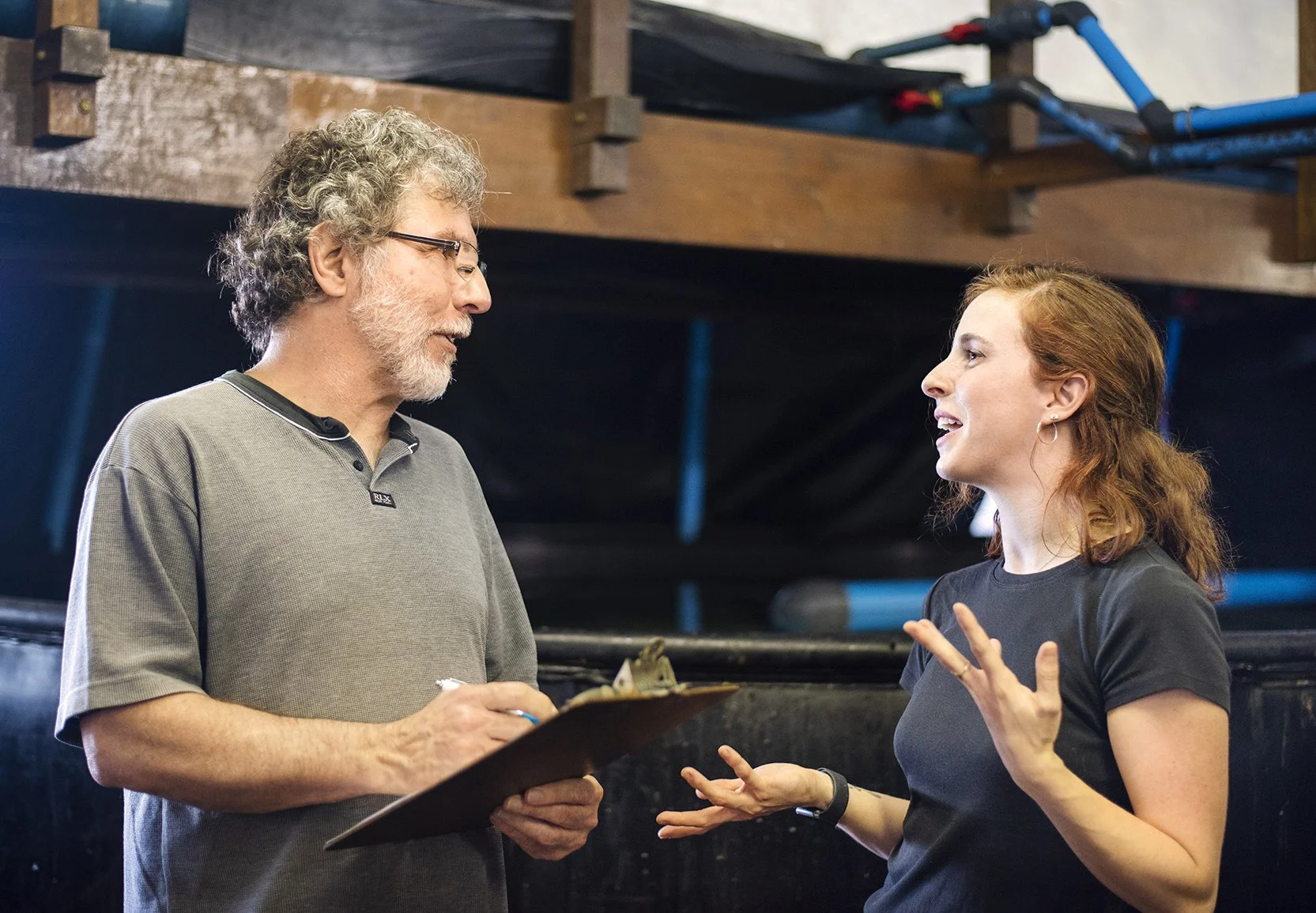
Sarah and Vernon met at the University of Cape Town, where Sarah began as a master's student in Vernon's marine biotechnology lab. What started as a student-supervisor relationship became a research partnership built on a shared conviction: that the animals we farm, and ultimately consume, deserve better from the science that supports their production.
Both studied microbiology and zoology at Rhodes. Both wanted to become wildlife vets but couldn't afford the fees. Both found their way to UCT, where they discovered proteomics and its power to reveal what's really happening inside an organism at the molecular level.
When UCT's Research Contracts & Innovation office encouraged them to spin out the technology, they took the leap. It meant taking the research further than a university lab ever could — and doing something meaningful in a critical, rapidly growing industry.
MariHealth Solutions was born in 2021. Not from a business plan, but from a shared belief that proteomics, and indeed biotechnology as a whole, could shift the needle on animal health and welfare in aquaculture.
THE CHALLENGE
The gap we saw
Aquaculture is the fastest-growing food production sector on the planet. It feeds billions of people and produces over 120 million tonnes of food annually. But the tools available to assess and protect the health of farmed fish are decades behind what's standard in human medicine — or even in terrestrial livestock production.
When something goes wrong on a farm, the first sign is usually a visible one: fish going off feed, abnormal behaviour, mortality. By then, the damage is already done. The diagnostic tools available (histology, blood chemistry, a handful of biomarkers) provide fragments of the picture, but never the full story.
We saw a different way. Proteomics doesn't look at one marker at a time. It quantifies thousands of proteins simultaneously, revealing the full molecular state of an animal — immune response, metabolism, stress, growth. All in a single analysis. It's the difference between checking one gauge on a dashboard and seeing every system at once.
The technology existed. The expertise existed. But nobody was applying it to aquaculture, at least not in the way we imagined.
OUR JOURNEY
Building it - the hard way
Aquaculture is notoriously conservative and slow to change. We learned that early.
We started by approaching farmers directly, the people closest to the animals. But the industry's immediate priorities were around production and yield, things proteomics can inform but doesn't solve overnight. So we pivoted — focusing further up the supply chain, where the demand for deep biological insight matched what we could deliver.
We've done all of this with a fraction of the resources available to our European and American counterparts. But we've had investors and a university that believed in us from the beginning — and we genuinely believe in what we're building.
Better science
for the animals that feed the world.
Want to be part of this story?
JOIN US
Whether you're a researcher, a feed company, a farmer, an investor, or someone who believes aquaculture deserves better tools — we'd love to hear from you.