
The One Question Every Salmon Farmer Should Ask Their Feed Supplier
Most salmon farmers evaluate feed on three things: FCR, price, and palatability. These are reasonable metrics -measurable, comparable, and tied directly to the bottom line. But after a few years of working with feed companies and researchers on the biological impact of feed ingredients, we’ve become convinced that this framework, however practical, is missing something fundamental.
There's one question almost nobody asks their feed supplier. And it might be the most important one.
Feed is your biggest cost. Is it doing what you think it is?
Feed accounts for somewhere between 50 and 70% of a salmon farm's total production costs. It's the single largest operational lever available to a farmer. And yet most farms still evaluate feed performance through what you can observe - growth rates, feed conversion ratios, visual health assessments. If the fish is getting bigger, we assume the feed is working.
But growing and thriving aren't the same thing.
A fish can show acceptable growth while simultaneously mounting an elevated immune response, running a chronic stress load, or struggling to absorb certain nutrients efficiently. None of these things necessarily show up in your FCR. None of them are visible to the eye. And yet all of them have real consequences - for long-term health, robustness under pressure or changing environmental conditions, and the quality of the animal at harvest.
What the research shows
The scientific community has been making this point quietly for some time. In a study published in BMC Genomics (Tacchi et al., 2012), Atlantic salmon fed either a high-marine-protein or a high-plant-protein diet both doubled in weight over 77 days, with no significant difference in feed efficiency, condition factor, or organ indices. On the bottom-line numbers, the two diets looked equivalent. But molecular analysis told a more complicated story - substantial transcriptomic differences across the mid-intestine, liver, and skeletal muscle, including in immune response and energy metabolism, that were entirely invisible in conventional performance metrics.
A more recent study on Chinook salmon (Esmaeili et al., 2022) used proteomics to compare feed-efficient and feed-inefficient fish, and found that the molecular differences weren't really about how much the fish ate. The efficient fish showed enrichment of protein synthesis pathways in liver and white muscle. The inefficient fish showed the opposite - enrichment of protein degradation and amino acid catabolism. Two distinct molecular strategies for handling the same diet, completely undetectable through growth and FCR alone.
We're seeing the same pattern in our own work. In a recent MariHealth pilot, rainbow trout fed a high-performance diet versus a standard growth diet produced cleanly opposing blood proteome signatures. One group's biology was geared for growth - active energy production, lipid utilisation, and pro-growth signalling. The other was absorbed in defence - chronic immune activation, ER stress, and suppressed proliferative signalling. Same species, same conditions; fundamentally different biology, all driven by the diet. The data is preliminary and warrants a larger trial, but the signal is unmistakable.
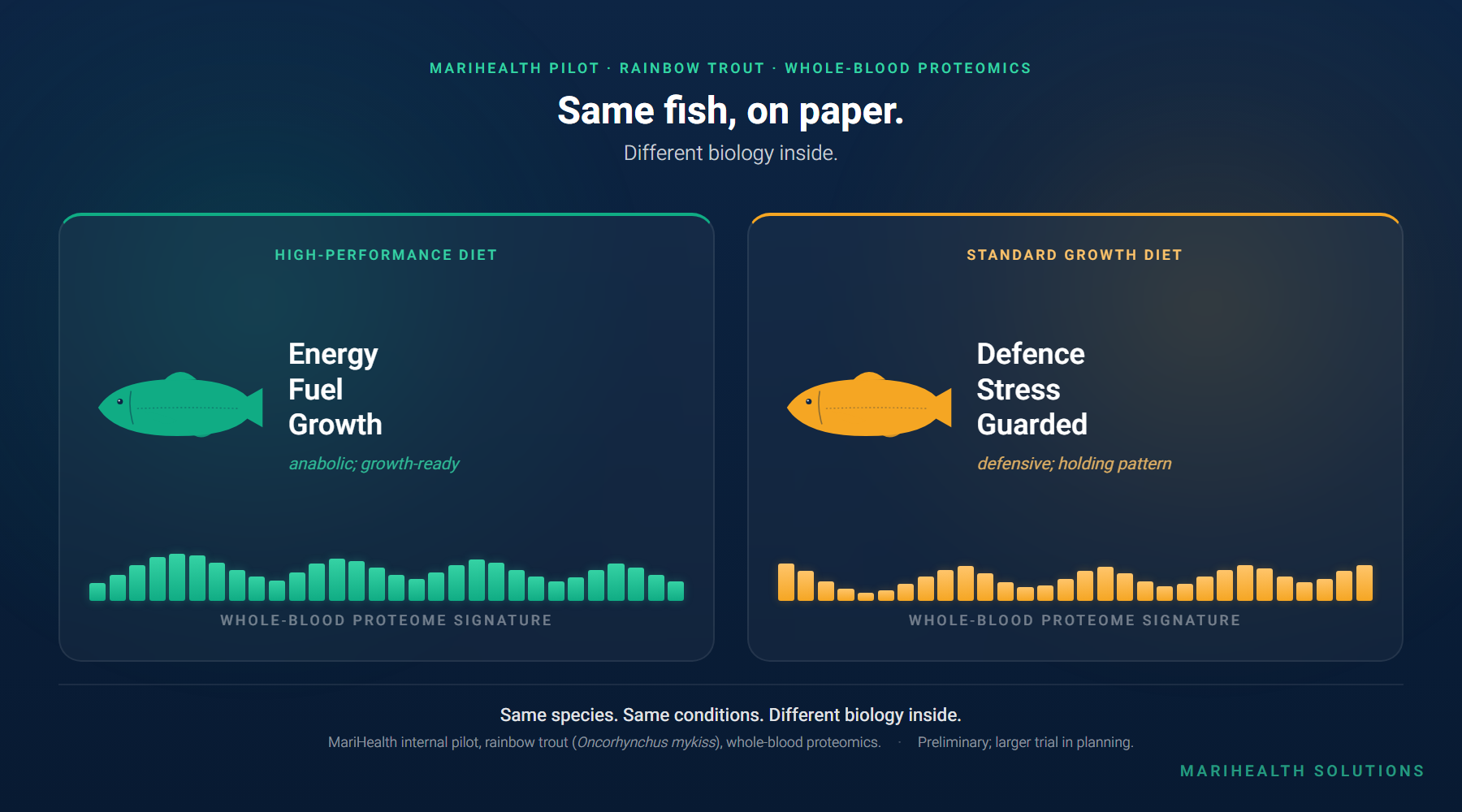
Two diets, two whole-blood proteome signatures. Same species, same conditions, fundamentally different biology. MariHealth rainbow trout pilot; preliminary, larger trial in planning.
This is the fundamental limitation of evaluating feed through outcome metrics alone. By the time a difference in FCR is measurable, the underlying biology has often been signalling for some time. The question is whether you have the tools to see it.
The question worth asking
What if you could look at what a feed or ingredient is actually doing to your fish's metabolism, immune function, and stress load - not in aggregate across a production cycle, but at the protein level, from a single blood draw?
That's what proteomics offers. By measuring 3,000+ proteins simultaneously from a non-lethal blood draw, we can map the biological response to a feed or ingredient with a level of granularity that growth metrics simply can't match. At MariHealth, this is precisely what our proteomics platform for feed and ingredient evaluation is designed to do — giving feed companies and farmers objective, molecular-level evidence of how ingredients affect fish biology, not just how they affect the FCR column in a spreadsheet.
We're not replacing FCR. We're giving it biological context - telling you not just whether the fish grew, but what the feed was asking of its body to get there.
The question we'd encourage every farmer to put to their feed supplier is this: "What does your feed actually do to my fish's biology?"
Not what it does to growth rates. Not what it costs per kilogram. What does it do at a molecular level - to the way the animal processes nutrients, manages stress, and mounts an immune response?
Why this matters for the whole supply chain
This isn't just a question for farmers. It's equally important for feed producers and ingredient suppliers.
In an increasingly competitive aquafeed market, the companies that differentiate themselves will be those that can demonstrate, with biological evidence, that their products do what they claim. Not just that fish grew, but that the ingredient supported metabolic efficiency, reduced inflammatory load, or improved nutritional absorption in ways that are measurable and reproducible. That's a different kind of proof point, and it's becoming increasingly important to R&D teams, procurement managers, and the regulators watching this space closely.
The data to answer this question exists. The technology to generate it is here. The industry is simply not yet in the habit of asking for it.
Maybe it's time to start.
Sources
Tacchi, L., Secombes, C.J., Bickerdike, R. et al. Transcriptomic and physiological responses to fishmeal substitution with plant proteins in formulated feed in farmed Atlantic salmon (Salmo salar). BMC Genomics 13, 363 (2012). https://doi.org/10.1186/1471-2164-13-363
Esmaeili, N., Carter, C.G., Wilson, R., Walker, S.P., Miller, M.R., Bridle, A.R. et al. An integrated proteomics and metabolomics investigation of feed efficiency in seawater reared Chinook salmon (Oncorhynchus tshawytscha). Aquaculture 562, 738845 (2022). https://doi.org/10.1016/j.aquaculture.2022.738845
